The Bard and the bridge of the Enterprise (or Why a Scifi Nerd Loves Shakespeare)

Yesterday I announced my New Year’s resolution to read the complete works of Shakespeare in 2012. Two points to clear up about that: what Shakespeare has to do with my science/science fiction/fantasy nerdiness and the story of what lead to my resolution. When I said you could blame it on Charlie Rose and his series of shows called “Why Shakespeare?” that wasn’t entirely fair. You’d also have to blame it on Star Trek and my great Aunt Fritzie.

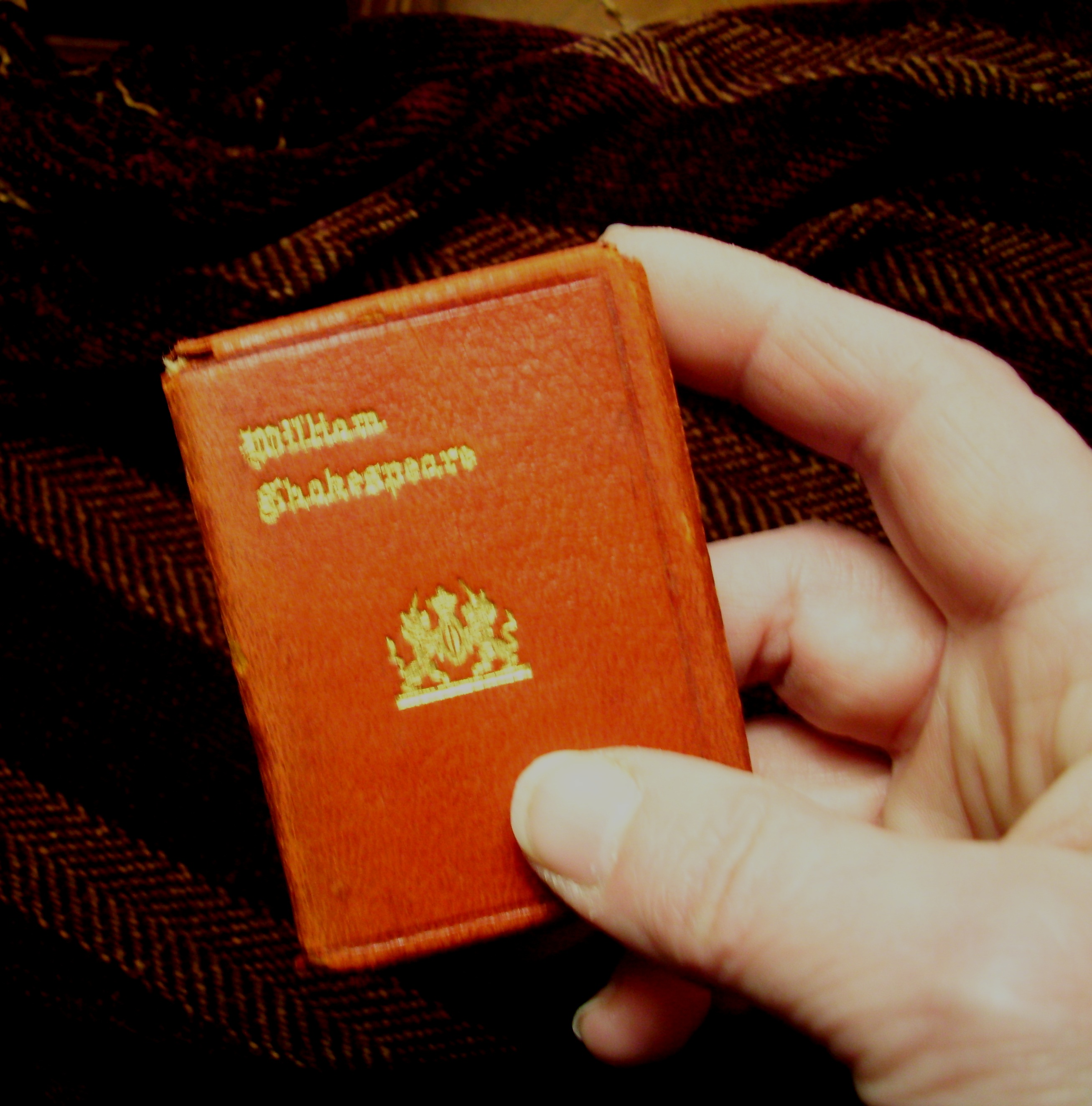
The Bard got his hooks in me at an early age. It all started becauseMiniature volume of Shakespeare's Taming of the Shrew we had this set of miniature books in our house. Still have them. (Picture at right.) I would pick them up and examine them long before I could read a word on their pages just because of their size. I thought, “If they’re so small they must be made for kids.” Also, their covers were interesting: each book bound in a different color and texture of leather. Then, inside, filmy thin pages like those in my Bible so I thought they must be important books. My mom told me I could look at them if I was careful. The set had been given to her by my great Aunt Fritzie who at one time worked as a cook for the Barrymores.  I had no idea who the Barrymores were or why there was an illustration the beginning of each book showing a young, but balding man with ruffles around his neck. I didn’t really care; I just wanted to be able to read the little books. Once or twice a year, I would try to read one of them, but even after I’d learned to read well in school, I couldn’t make heads not tails of what was going on in those pages. (FYI: the Barrymores mentioned were Drew Barrymore’s grandparents. Her grandfather John Barrymore, noted for his stage portrayals of Hamlet and Richard III.)

Third grade, fourth grade fifth grade, still not much luck. I knew each of the little books contained one of Shakespeare’s plays, but aside from the titles and figuring out that dramatis personae was the list of characters, the contents remained a mystery. Then…

Star Trek. First show I begged my parents to let me stay up past my bedtime to watch. Little did I know that while glued to the TV set following the voyages of the starship Enterprise, the Bard was beginning to seep into my brain. As Duane Morin wrote in his Shakespeare Geek blog, “Every good geek knows that Star Trek is loaded with Shakespeare references.” “Dagger of the Mind,” “Conscience of the King,” “All Our Yesterdays,” “By Any Other Name” —all episode titles from the original series and all references to Shakespeare.  The trend continued in the movies. The title Star Trek VI: The Undiscovered Country refers to Hamlet’s famous “to be or note to be” soliloquy: “…the dread of something after death,/The undiscovered Country, from whose bourn/No Traveller returns…”

So fellow nerds, the Bard’s probably already got his hooks in you, too. Next time you quote Star Trek, remember you just may be quoting Shakespeare.

By the time Star Trek the Next Generation arrived, I’d read many of the Bard’s plays, see most of the film versions, even caught a few stage performances. Watching the first episode of STTNG, I wasn’t sure if I’d like the new series, but I was willing to give it a try because of Picard’s love of both Shakespearean drama and “tea, hot, Earl Grey” —both loves of mine. In short, a perfect circle: Star Trek leading to my love of Shakespeare, Shakespeare leading me back to Star Trek.

Posted in A Year of Shakespeare, sci fi shows, Shakespeare, Star Trek | Tagged , , , , | Comments Off on The Bard and the bridge of the Enterprise (or Why a Scifi Nerd Loves Shakespeare)

Blame it on Charlie Rose: A nerd’s 2012 Shakespeare resolution

So, I’ve been pondering New Year’s resolutions and decided what one of them will be: to read the complete works of Shakespeare.

Why?

Blame it on Charlie Rose, the hero of my better self, who with his passion, gentle humor and endless curiosity never fails to engage my mind and curiosity through the discussions on his PBS talk show. Occasionally, he chooses a topic on which to build a series of shows, the most recent being “Why Shakespeare?” After looking at his website, I found that it started back in November, but I’ve been behind on watching the shows in my queue.

Just today, Rose’s December 28th show caught my eye because of the lineup: Liev Schreiber, Jim Schapiro and Ken Branagh. Hadn’t heard of Schapiro until today, but the names bookending his are very familiar. So I watched the show and it stirred my fascination with Shakespeare once again.

Liev Schreiber talked about performing the Scottish play and the music of the language found in Macbeth’s speeches. Ah, yes. Familiar territory for me. The sound of Shakespeare’s lines has drawn me in from the beginning—the flow of one word building upon the next, the rhythm of the lines, the familiar juxtaposed with the strange. Even before the meaning of even one line of the Bard’s work became clear in my mind, it was the words’ music that made me listen, read, want to understand.

Jim Shapiro spoke of King Lear, a play I have not read and never seen performed. Schapiro, a Columbia University professor, has an upcoming book called The Year of Lear: Shakespeare in 1806. Hearing Shapiro explain why Lear speaks to him made me understand a little more why I’ve heard so many of the actors I admire speak of looking forward to the opportunity to perform the lead role when they attain the appropriate age with all the longing that adolescents use when saying, “I can’t wait till I’m old enough to get my driver’s license.”

Then, Ken Branagh discussed the importance of continuing to ask Rose’s question, “Why Shakespeare?” Branagh recently reread King John (another of the plays I’ve never read) and commented on how pertinent it was for today’s world. “If you read King Johnright now and then put it down and…pick up The Economist” and read about the Greek debt crisis….” Hmm. Perhaps I should read that one, I thought to myself.

My set of Shakespeare's works. Taking my first look at King John.

And so the New Year’s resolution popped into my head. I got up, pulled down my boxed et of Shakespeare’s works and found the volume containing King John, put it on my nightstand, and then decided I’d need a bit of outside pressure to live up to the challenge. Blog, the muse, demanded, so blog I have.

What have I gotten myself into?

Succeed or fail in this 2012 resolution—at least that will be something to blog about.

Posted in A Year of Shakespeare, Shakespeare, writing | Tagged , , , , | 2 Comments

Zombies & Supernatural: When Spooky Seeps Into Your Psyche

So…maybe I’ve been working a bit too long on writing zombie stories. And much too into Supernatural. I just saw an ad for a restaurant—a photo of barbeque ribs—and the first thought that came to mind was: Ew. Look at that charred, ripped open ribcase. Granted, it’s accurate and vegetarians the world over would agree with my assessment of “Ew.” However, I’d say it’s a sign that after I finish my novel of the zombie apocalypse, I’d best give my psyche a break and write about angels and puppy dogs and rainbows. Like that’s gonna happen. Maybe hot angels (like Supernatural’s Castiel), werewolves and, well, I can’t really think of a cool equivalent for rainbows. Although, I did, just today, start toying with the notion of a story with a hot leprechaun —sort of a Tolkienesque Elvish take on leprechauns with nothing at’all wee about these folk. Just the way my mind works.

Back to the ribs. I know exactly why my mind slid so quickly into the goriest interpretation possible: I’d just watched “Are You There, God? It’s Me, Dean Winchester” from Supernatural, season 4. That’s one of those episodes where vengeful ghosts tear apart those who done them wrong in life. (Lots of episodes where that happens, so not a spoiler for those who are caught up on the Winchester boys’ adventures.) Why re-watch season 4 when the new season just started this past Friday? Such a silly question. One episode a week is just not enough Dean, Sam, Bobby and Castiel.

Aside from that, I’ve been looking forward to the next half season of Walking Dead. (That’ll be a long wait, since I dropped down to just basic cable, but at least I know the new episodes will be out there soon.) Oh, and what did I do last weekend to take a break from my zombie novel? I wrote an unrelated zombie story for an eBook anthology (due out by Halloween; more on that later).

As a change of pace, I did watch the latest Doctor Who episode tonight, but it seems that didn’t take my thoughts far enough away from gore and blood. Perhaps if I watch the Pan Am pilot before I go to bed? But no. Set in a time when women turned to flying the friendly skies in form-fitting outfits to search for adventure and/or a husband—that might be the scariest scenario of the evening.

Posted in writing | Tagged , , | Comments Off on Zombies & Supernatural: When Spooky Seeps Into Your Psyche

Nerdist.com Writers Panel 8 Podcast: #1 on my list

Okay. So, I’m late in talking about Nerdist.com and in listening to the podcast Nerdist Writers Panel #8 from June 12, 2011. (Been slaving away at finishing up my zombie novel, so not much free time.) But now that I’ve listened to this podcast: woot! So good, I’ll probably listen to this one a second time.

This panel consisted of Amy Berg (Eureka); Ben Edlund (The Tick; Angel; Supernatural); Angelina Burnett (Boss; Memphis Beat). Not only were there a lot of inside stories from TV shows I love, but there was an avalanche of great advice on writing.  I strongly recommend it to any of you aspiring script writers out there. Or just fiction writers who want to take some tips from episodic TV to tighten up plots.

Posted in sci fi shows, writing | Tagged , , , , , , , | Comments Off on Nerdist.com Writers Panel 8 Podcast: #1 on my list

Knights of Badassdom…Needest us this?

Oh yes, dost we ever. Steve Zahn (Treme), Peter Dinklage (Game of Thrones), Summer Glau (our Firefly connection), and Danny Pudi (Abed on Community and a Chicago native), among others, all in a very silly movie where LARPing meets supernatural meanies…what’s not to like? At least the trailer looks good:

It’s causing a buzz at Comic-Con. Will the film turn out to be as good as the first glimpse? Could this be the Galaxy Quest of larperdom? I hopest so. I haven’t seen a really fun flick since Dr. Horrible’s Sing-Along Blog hit the web back in 08.

Posted in Fantasy, movies | Tagged , , , , , , | Comments Off on Knights of Badassdom…Needest us this?

Nerd Writes on Twitter

Spent part of the long weekend starting a new Twitter account (how many is this that I have now? too many? not possible! well…maybe) just for Nerd Writes. Why? Well…

I have another relatively new Twitter account for my purely science, sans the fiction, interests (dotscoolscience — website to follow soon) and I’ve found it to be such a valuable resource that I wanted to do the same for my writing and scifi/fantasy/horror interests. I’ve started searching out the peeps and organizations that are important to my little ol’ nerd writing heart. And, of course, I’ve tweaked the design.

This guy won the contest to be my Nerd Writes profile rep. (No fruity oaty bar girls were hurt in the shooting of this picture.)

One of Wash's dinos getting psyched about the Fruity Oaty bar lunchbox.

One of Wash's dinos getting psyched about the Fruity Oaty bar lunchbox.

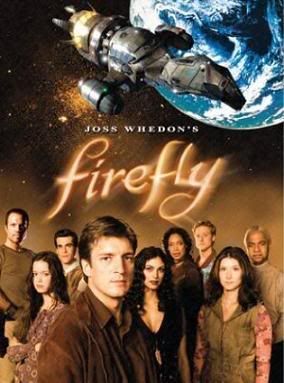
Posted in Firefly, writing | Tagged , , , | Comments Off on Nerd Writes on Twitter

Game of Thrones, Girls and Mad Men

So, I finally got around to reading Ginia Bellafante’s April 14th review of The Game of Thrones “A Fantasy World of Strange Feuding Kingdoms” but only after I read Amy Radcliffe’s response to it on Tor.com, which should tell you something right there. I’d been warned about Bellafante’s review by a friend. He ran down the lowlights of the review for me, including her description of the series as “boy fiction patronizingly turned out to reach the population’s other half.”  Now that I’ve read the review, I see that Bellafante thinks the illicit sex scenes were “tossed in as a little something for the ladies.” This tells me two things: she’s never read George R.R Martin’s books and she probably has never seen a Bond film. (Gee, here I always thought that the sexy women and bedroom scenes were thrown into those for the “boys.” Guess I was wrong.) I won’t defend women who read epic fantasy here; that’s been ably done by Radcliffe in her rebuttal. Thank you, Amy Radcliffe and thank you, Tor.com.

I find it interesting that Bellafante opens her review by contrasting “Game of Thrones” to “Mad Men” in an effort to show how horrible it is that HBO has spent so much money on this fantasy series that she—if I’m not reading it wrong—hates. Hmmm. “Mad Men.” Isn’t that the soap opera-like show that has large number of principle characters and serves up a lot of confusion in the name of no larger or really relevant idea beyond notions that the advertising business is ugly, families are insidious and power is hot? Oh, excuse me, I’ve almost directly quoted Bellafonte’s rant about “Game of Thrones” except for changing a few words (“advertising business” for “war” ) and leaving out a few. The few I left out were “sketchily fleshed-out” before “notions.” Considering that we’ve seen four seasons of “Mad Men” maybe that’s why it doesn’t seem sketchy?

To set my record straight, I think “Mad Men” is a great series. I loved the look of it from the first episode. I was eager to see how all the principle characters’ stories would be interwoven and set against the background of larger world events. The series has great costumes, attention to detail in the sets, excellent cinematography that helps to reveal mood and underlying tension. The same can be said of the first episode of “Game of Thrones.” I’ll have to see it “Thrones” lives up to that standard through this first season before I call it a great series. It does have one big advantage over “Mad Men” though—strong women characters who aren’t hobbled by the social shackles of the sixties. Yes, within the sixties ad biz world we’ve got Joan, played by Christina Hendricks, and Peggy, played by Elisabeth Moss, but watching women struggle to work within a male dominated business is not as satisfying as seeing a woman wield power from a throne or take charge of an army of  Dothraki warriors. One of the things this girl isn’t sold on is all that illicit sex. Will there be too many sex scenes thrown in, trading story time for ratings grabs? I’m hoping the balance will tip in favor of character, action and complex political intrigue.

But then, I’m one of those girls who don’t join book clubs because those I’ve run into tend to select novels about broken marriages, abusive relationships, troubled childhoods—and nothing else. When I read for leisure, I like to be taken away from the troubles that can drag us down in real life. I want suspense, romance, fantasy, science fiction. Would I want to discuss The Hobbit in a book club (an idea that seems to confound Bellafonte)? It wouldn’t be my first choice because there’s not that much meat to the story. It’s not The Lord of the Rings, which does have a lot to discuss but it’s a triology. And therein lies the nerd book club dilemma: most of the good stuff is very, very long, so not good book club fodder. It is, however, great stuff for re-reads and online discussions. (Thank you again Tor.com.)

To be fair, Bellafonte is probably just suffering from genre prejudice, which I’ll define as an imagination-limiting tendency to confine one’s reading to mainstream and “literary” novels, with an inclination to denigrate any other kind of writing. If “Game of Thrones” was a series set in Medieval England, would she have the same problems with the large cast of characters? If part of the story took place in Rome and the actors spoke in Italian, seeing that it is a language “for which we already have a dictionary” unlike the Dothraki language of Martin’s story, would that be okay with her? (Tip to Bellafonte: think of house “Lannister” as “Lancaster” and pretend it’s English history.) Her complaint about HBO looking “cheap” when it “ventures away from its instincts for real-world sociology” tells me that she can’t see truths about the “real world” in a story unless they are told in contemporary settings. In the real world we are dealing with problems caused by war, unsettling family dynamics, and problems caused by people thinking power is hot, aren’t we?

Whereas I see an added point of interest in weaving elements of fantasy into such a story, Bellafonte can’t seem to see the real world issues for the fantasy. From her review, it seems that she has trouble getting past the swords, strange languages, and strange cultures. Getting caught up in the surface details, she shows that she’s unfamiliar with the genre of epic fantasy. Then, she veers to the other extreme: digging in too deep to demystify the popularity of Martin’s story.  She latches on to the unusual climate of the fantasy world and concludes that “Game of Thrones” is “a vague global-warming horror story.” Huh. Wonder if she sees “The Wizard of Oz” that way, too? Could the Emerald City be the first example of a green economy? Goes to show how different two girls can be. I’m attracted to the series by surface details (swords, scenery, Sean Bean) but I see the deeper story as one of politics and survival in a war torn nation. The long winter and impending threat of terrifying inhabitants invading from the north beyond the wall? Hmmm…let’s see. Perhaps: the eternal battle between light and darkness. Or maybe this: a long winter and impending threat of terrifying inhabitants invading from the north beyond the wall—otherwise known as an important story driving plot point.

While Bellafonte hungers “for HBO to get back to the business of languages for which we already have a dictionary,” I hunger for more series where I expand my world by learning new languages and expand my perception of real world sociology by observing its machinations in an unfamiliar setting.  As a side note, because of her review, I am starting to have a craving to join her book club (if she belongs to one) just so I can “stand up in indignation” and refuse “to read the latest from Lorrie Moore unless everyone” agrees to read “The Warded Man” by Peter V. Brett, no doubt another novel Bellafonte would find too confusing.

For those of you who do like Game of Thrones, there’s tons of cool info on the official HBO site.

Posted in Fantasy | Tagged , , , , | Comments Off on Game of Thrones, Girls and Mad Men

Baby robot dinos, you make me smile.

This is an old video, but thought those of you who haven’t, might like to meet PleoTM at least in the virtual world.

Posted in robots | Tagged , , | Comments Off on Baby robot dinos, you make me smile.

Automate 2011: Dr. Ron Diftler, Anybots and Pleo

I’ve been missing the robots.

Sitting here in front of my Compaq laptop (with only 584MB of RAM) is a far cry from the cool tech I saw back in March at Automate and Promat 2011. Automate, formerly the “International Robots, Vision & Motion Control Show,” started in 1977. Promat is a trade show and educational conference on “material handling and logistics industry.” These conventions, held every two years, present information and practical solutions in robotics, machine vision and motion control for use in aerospace to food & beverage industries and everything in between. This year (luckily for me of the little time-to-spare and limited budget) the duo-cons are taking place in my home town of Chicago. It’s a four day event (March 21-24), of which I was able to attend just one day so I chose Tuesday—the best day for robot enthusiasts.

Sunila Samuels, my friend and fellow fiction writer (check out her blog Robot Dance Mob) gave me the heads-up on the event back in fall 2010. We’ve been looking forward to it since then and the experience didn’t disappoint.

Tuesday morning 8:45am, March 22, 2011, there we were at McCormick Place North, room S102 for the day’s keynote on “The Development of Robonaut 2: A Story of Government-Industry Collaboration and Technology Transfer For The Next Generation of Robotic Solutions.” Long title made short: R2, first humanoid robot in space, an overview. The speakers were Dr. Ron Diftler, Robotnaut Project Manager for NASA Johnson Space Center, and Marty Linn, Principle Engineer of Robotics for General Motors­—both the coolest of dudes by my reckoning. (In case, they care: we were the two women in the 3rd row on their right sides, taking copious notes and no doubt sporting wide goofy grins through most of the talk.) We learned lots of details about the development and mechanics of Robonaut as well as the collaborative efforts between NASA and GM engineers for the ongoing project. I have to say that Dr. Diftler gets my vote for best lines from the talk. Asked about whether or not tactile information could be transferred from R2 to the human teleoperator, he said it would be possible once they found the right device, but that the systems tried out so far resulted in a painful experience for the teleoperator and seemed to have been “designed by the Marquis de Sade.” On the topic of the R2’s power usage on the International Space Station, Diftler explained that recharging can be done either through the robot’s own battery or on the tether network inside the station and said that way “we could recharge ourselves” however it’s most convenient.

Speaking of anthropomorphizing robots…there was just no way to avoid it in the exhibit halls for either Automate or Promat, especially in Automate’s “Emerging Robotics Pavilion.” Perhaps our favorite robot on display was the Anybot QB, a mobile telepresence robot, one of which sported a bow tie. Anybot has real-time 2-way video and audio, weighs 35 lbs, and self-balances on two-wheels. Using this robot as your proxy, you can talk to people, walk with them and see what’s happening without physically traveling to their location—in other words, be there now without actually being there. Not bad for the cost of $15,000 per unit.

Another very nerdy thrill for me was seeing PleoTM first hand. I discovered this cute little dinosaur/artificial life form a couple of years back while web surfing at PleoWorld.com. In the site’s introduction video, Derek Dodson, COO of Innvo Labs, describes PleoTM as a “robotic companion pet” and there’s no denying it fills that role admirably. The latest generation of this cute baby dino will run you $469 USD + more for accessories such as the Learning Stone value packs that teach it to sing, play, dance and even count. Is it worth that amount of shiny, cashy money? It is more affordable, not to mention cuddlier than an Anybot. Should I ever win the lottery, I’d certainly buy one, but for now I’ll stick to my biological pets. Although, if I review the expenses, I know my cat and dog definitely cost more in the long run.

In the non-cute or cuddly but very cool category of robots, I have to mention Motoman Robotics’ Dexter Bot. Motoman, a division of Yaskawa American, Inc., has programmed this dual-arm SDA robot to play Black Jack. The addition of a three-finger grip was demonstrated by a headless version in a smaller booth at the “Emerging Robotics Pavilion.” I have to say that the headless-robot seemed more human-friendly to me. The first inkling of unease came from Dexter Bot’s TV-serial-killer first name, but it was the thin line of Cylon-like red lights flashing within its face plate that kept me at dual-arm’s length.

The closer science reality gets to our science fiction visions, the more the manufacturers will have to aware of pop culture references and avoid the creepy ones in their products, especially if the goal is smooth human-robot interface in the workplace or home. There’s a long way to go before real robots have the capacity go the route of R2D2 and C3PO or Cylons and Terminators. In the meantime, I’m looking forward to seeing the next generation of innovations at Automate 2013.

Posted in robots | Tagged , , , , , , , , | Comments Off on Automate 2011: Dr. Ron Diftler, Anybots and Pleo

Strange Dreams, Koontz and (briefly) King – Part 2

Back to the review for Koontz’s most recent and another trend that puts pressure on some authors to write faster and publish more often. The Publishers Weekly reviewer compares Koontz’s novel What the Night Knows to the movie “Fallen.” I’d prefer reviewers of print to compare apples to apples, but I understand the reason for the film reference. Readers have come to expect suspense, horror, fantasy and science fiction novels to be as fast paced as the blockbuster movies we go to see—one of the signs of our changing tastes in literature that no writer of popular fiction can ignore. I’m not saying it’s a bad thing, but it’s definitely tough to compete with films. Words on the printed page, no matter how visceral and dynamic the language, don’t have the slam bang factor of visual special effects, nor can they rely on musical scores to heighten the emotional reaction of the audience. A book is a different species of entertainment than a film. Each art form has its own strengths and limitations, so why expect one to follow the same rules as the other?

Where once there were two distinct markets, it’s not as easy to separate film goers from readers anymore. To entice more people to buy books, publishers must look for faster pacing and less description in the books they publish. In response, many writers adopt a style of shorter chapter length—sometimes as short as two or three pages, which doesn’t leave much room for in depth character exploration. Any hint of philosophic or moral dilemma must be shown in a few words, lines or details, akin to the close-ups and one-liners in a film. Quite a challenge for any writer—in novels or screenplays. Occasionally, restrictions on pacing and chapter length work for a writer, even define his or her style. Robert B. Parker, for example. As a fan of his Jesse Stone series, I’m in love with the way he marries the terse hero to the spare writing style. Result: easy books to make movies from and easy for the reader to feel like she’s seeing a film script as she reads. But that’s not a style that works for every writer or for every story. Good for fast-paced plots, bad for character driven stories or for novels where atmosphere, world building or large casts of characters are required.

On to Stephen King. Not one for short chapters or restricting anything where it comes to word count. Wikipedia credits him with 49 novels so far, but since they’re each usually long enough to count as two novels, let’s just say that for both he and Koontz, the word prolific is an understatement. (Maybe a new word: kingoontzic. Maybe not. Let’s just say both of them make me feel woefully lazy.) I’ve probably read less of King’s work than Koontz’s, but enough to know that what I said above goes for this writer, too, i.e. admiration, respect—enough to study his style and listen to what he says on the craft of writing. Oddly enough, I think I’ve seen more King than I’ve read. Maybe it’s just a habit I got into early on. Having heard how scary The Shining was from one of my friends in high school, I decided to see the movie before I read the book—using the film as a way to prepare for the longer scare. It’s also made me expect, perhaps more than with other authors, that there will be much more story to the book than the movies. I also have the benefit of the movie or mini-series visuals in my head to carry me through the many pages of a King mega-novel. (Visualizing Gary Sinise as Stu Redman went a long way to get me through the 1141 pages of the complete and uncut version of The Stand.)

Perhaps, in a way, I’ve been ahead of the curve in wanting a film experience from books. After all, the PBS series based on War and Peace is what helped me achieve my goal of reading Tolstoy’s Stephen-King length masterpiece. (At 1475 pages in the paperback version I read, it’s got only 334 on my copy of The Stand.) Should we start promoting novels as movies and mini-series in print? Crime novels with reoccurring protagonists could be advertised as print version episodes. That way people may have an easier time choosing books to read: “Gee, I don’t have time to read a Stephen King mini-series right now. I’ll read the Koontz TV movie instead.” Of course, that would only turn up the pressure on bestselling authors to churn out more novels faster.

I can’t imagine what it’s like to have the long run of King or Koontz and still have to face a critic or reader’s disappointment. (Although I’m sure massive sales make up for that in many ways.) Not to worry. I’ll never have a writing career or have deal with the problems of a Koontz or King. I simply don’t have enough time. No matter how hard I try, I can’t find enough hours in the evening after work or on the weekends to churn out the required word count. And, even if every submission I made from now on gets accepted, I got my first publishing credit much too late in life compared to those two. I should just enjoy my nightmare of the other night. Why complain if it means my muse is still spurring me on to write more, faster, and better?

Posted in Dean Koontz, Stephen King, writing | Tagged , , , , , | Comments Off on Strange Dreams, Koontz and (briefly) King – Part 2